Die Casting Heat Treatment - T5 and T6 Explained
Die casting heat treatment with T5 artificial aging and T6 solution treatment: improve tensile strength 20-30% and yield strength 40-50% on aluminum parts.
Production Capabilities
Supporting visuals for die casting heat treatment
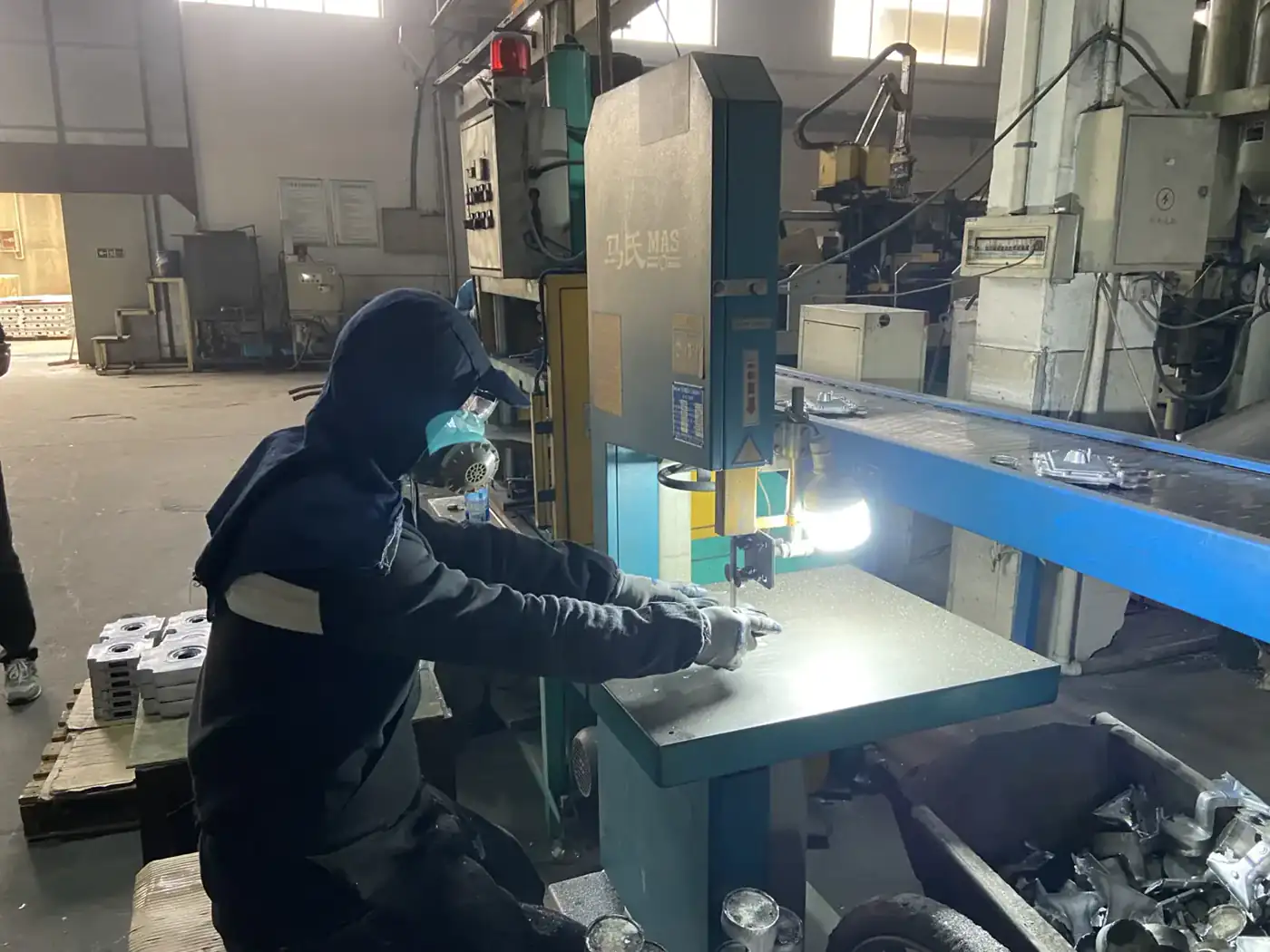
Production Workflow
Die casting machining, finishing, tooling, and assembly operations at our Nanjing facility.
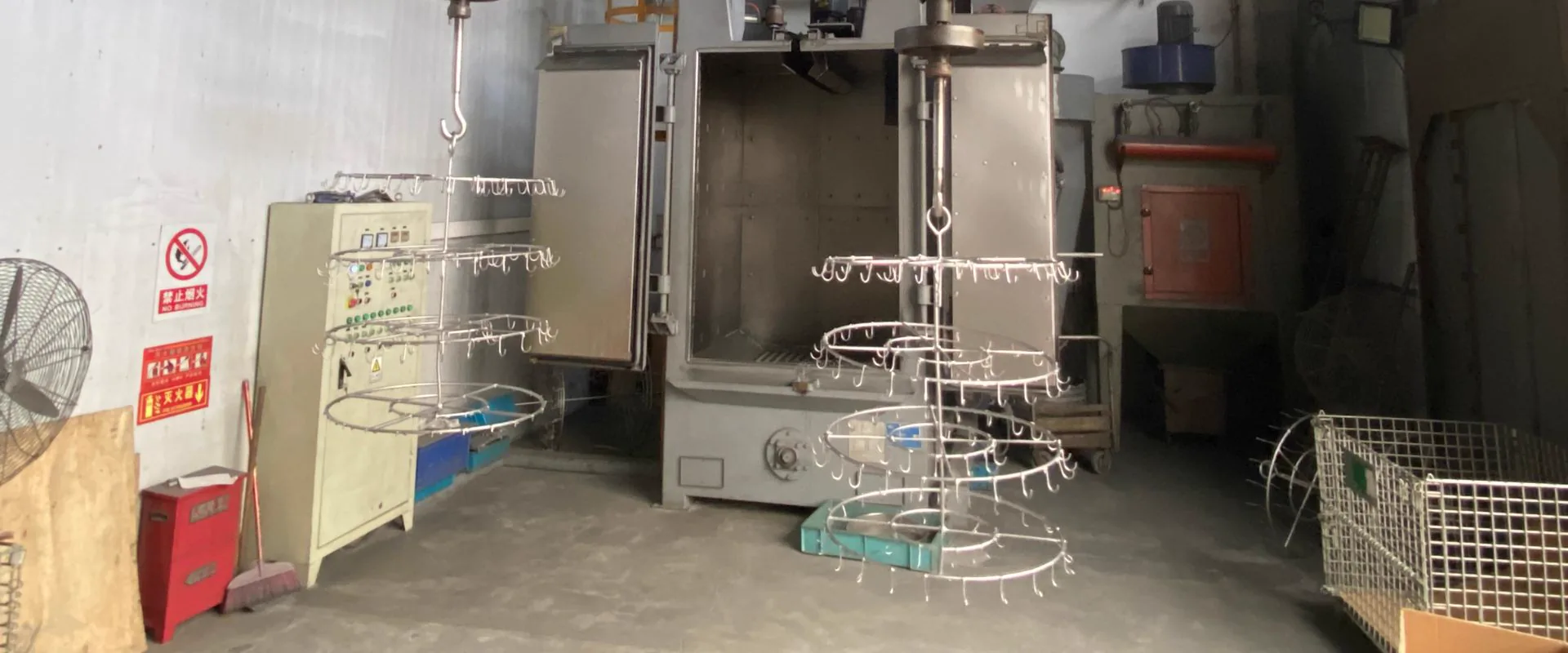
Quality Detail
Close-up views of tooling precision, machined features, surface finishes, and inspection procedures.
Heat treatment of aluminum die castings can increase yield strength by 30-50% over as-cast values without changing geometry or adding weight. For structural, load-bearing, or safety-critical castings, the temper you specify is often the difference between passing and failing the mechanical property requirements on the drawing. This page answers the two questions that matter when specifying: T5 or T6 — and can the casting survive the cycle that temper requires?
Aluminum Temper Designations
Temper designations follow the Aluminum Association T-code system used for both wrought and cast alloys:
| Temper | Name | Process | Typical Use |
|---|---|---|---|
| F | As fabricated | None | Baseline; non-critical parts |
| T5 | Artificially aged | Casting cooled from the shot, then aged 150-175°C | Standard HPDC parts needing moderate strength gain |
| T6 | Solution treated + artificially aged | Solution treat 480-540°C, quench, then age 150-175°C | Maximum strength; requires low-porosity casting |
| T7 | Solution treated + overaged | Solution + quench + aging beyond peak (higher temperature or longer time, e.g. 200-240°C range) | Dimensional stability and stress-corrosion resistance, at reduced strength |
T5 vs T6 vs T7 — Comparison
| Factor | T5 | T6 | T7 |
|---|---|---|---|
| Process steps | Aging only | Solution + quench + aging | Solution + quench + overaging |
| Typical cycle | 150-175°C, 3-5 hours | Solution 480-540°C (alloy-dependent), then aging 150-175°C, 3-12 hours | Same as T6 through quench; aging beyond peak condition |
| Works on standard HPDC? | Yes | No — blisters (see below) | No — same blister risk as T6 |
| Strength gain vs as-cast | Moderate (yield +30-40%) | Highest (yield +50-80% on responsive alloys) | Below T6 peak; above as-cast |
| Distortion risk | Very low — no quench | Moderate — quench + solution exposure | Moderate — same quench step |
| Dimensional stability | Good; relieves casting stress | Good after aging | Best — the reason to specify T7 |
| Typical adder | Small; quoted per project | Highest; may require vacuum casting — quoted per project | Similar to T6 — quoted per project |
Practical selection: T5 for standard HPDC parts that need better yield strength than as-cast. T6 when the drawing specifies true solution-treated properties and the part can be produced with low enough porosity (vacuum HPDC, low-pressure, or gravity). T7 when tight dimensions or stress-corrosion resistance matter more than peak strength.
T5 — Artificial Aging Only
Parts go directly from the casting cell into an aging oven at 150-175°C for 3-5 hours. Rapid solidification in the die leaves alloying elements (copper, magnesium, silicon) in a supersaturated solid solution; the aging hold precipitates fine strengthening phases that impede dislocation movement.
Typical T5 results on A380 (published values vary by source):
| Property | F (as-cast) | T5 |
|---|---|---|
| Tensile strength | 317 MPa | ~330-360 MPa |
| Yield strength | 159 MPa | ~185-215 MPa |
| Hardness | 80 HB | +10-20% |
Why T5 is the default for die castings:
- No quench and no solution soak — no thermal-shock distortion, thin walls stay straight
- 3-5 hours total furnace time — small cost adder, short lead time impact
- Safe on standard HPDC parts because there is no high-temperature soak to expand trapped gas
T6 — Solution Treatment + Artificial Aging
T6 delivers the maximum property improvement through three stages:
Stage 1: Solution Treatment
The casting is held at 480-540°C (alloy-dependent — A380-class alloys around 500-505°C, A356 at 535-540°C) for several hours. Strengthening precipitates dissolve into a uniform solid solution. The alloy is at its softest and most ductile in this stage.
Stage 2: Quench
Rapid cooling in water (or forced air for distortion-critical parts) freezes the supersaturated solid solution.
Stage 3: Artificial Aging
A hold at 150-175°C precipitates fine coherent precipitates (CuAl₂, Mg₂Si) that impede dislocation movement — the actual strengthening mechanism.
Typical T6 results on A380-class alloys (published values vary by source):
| Property | F (as-cast) | T6 (vacuum/low-porosity casting required) |
|---|---|---|
| Tensile strength | 317 MPa | ~360-390 MPa |
| Yield strength | 159 MPa | ~290-320 MPa |
| Elongation | 3.5% | ~4-6% |
| Hardness | 80 HB | ~88-95 HB |
The Blister Problem: Why Standard HPDC Cannot Take T6
Conventional high-pressure die casting injects molten metal into the cavity in well under a second. The air inside cannot escape fast enough and is trapped as microscopic gas pores, along with hydrogen dissolved in the melt. The part passes X-ray and leak tests and looks fine — until it goes into a T6 solution furnace.
At 480-540°C, trapped gas expands. Gas near the surface pushes the still-soft metal outward, producing surface blisters, and the high-temperature soak can soften interdendritic eutectic phases enough that surface segregation ("sweating") appears. The casting is scrap.
This is why most aluminum die castings are shipped in F or T5 temper. T5 peaks below 180°C — nowhere near hot enough to expand internal gas — so it is safe on conventional HPDC parts.
If your drawing calls for T6 on a die casting, there are three legitimate paths:
- Vacuum-assisted die casting (VADC). The die cavity is evacuated before injection, cutting gas porosity to levels that tolerate solution treatment without blistering. This is the standard route for T6-qualified HPDC parts — and it must be decided before the die is cut, because the die is built with vacuum valves and a sealed shot sleeve.
- Pore sealing before T6. Vacuum pressure impregnation (VPI) fills surface-connected pores with sealant and suppresses blister growth. It works for some parts but does not fix deep gas porosity.
- Change the process, not the alloy. Low-pressure die casting and gravity casting fill the cavity under laminar, low-turbulence conditions with inherently low gas content. Alloys designed for these processes (A356 is the benchmark) take full T6 routinely — which is why wheels and suspension brackets are made this way, not by HPDC.
If none of these is available, specify T5 and set the drawing properties accordingly. A T5 part that meets spec beats a T6 part that blisters in the furnace.
Which Alloys Respond — and Which Do Not
Response to heat treatment depends on the alloy's precipitate-forming elements. Magnesium forms Mg₂Si; copper forms CuAl₂. Alloys with neither respond poorly regardless of process.
| Alloy | As-cast tensile / yield (MPa) | T5 response | T6 response | Notes |
|---|---|---|---|---|
| A380 | 317 / 159 | Moderate — standard HPDC safe | Possible on vacuum castings | Copper-bearing; most common structural HPDC alloy |
| ADC12 | 310 / 160 | Moderate — standard HPDC safe | Possible on vacuum castings | Similar to A380; see ADC12 |
| A360 | 317 / 172 | Good — Mg-bearing | 300-320 / 230-250 MPa on vacuum/low-porosity castings | Best T6 response of common HPDC alloys |
| A413 | 290 / 130 | Poor | Poor | Near-eutectic; no Cu, minimal Mg — nothing to precipitate |
| A356 (LPDC/gravity) | ~170-200 / ~90-120 (F) | Good | Excellent — 260-310 / 200-270 MPa, 3-8% elongation | The structural T6 alloy; not an HPDC alloy |
Manage expectations against wrought alloys. Even a well-executed T6 on a die casting alloy lands near — not beyond — wrought 6061-T6 (~310 MPa tensile / ~275 MPa yield). High-silicon die casting alloys trade peak heat-treated strength for castability and die life. If the drawing was written around 6061 or 7075 properties, the right answer is usually a different process (low-pressure or gravity with A356), not a harder heat treatment on an HPDC part.
Distortion and Machining Order
Heat treatment moves metal. Solution treatment relieves residual casting stress, and quenching introduces new thermal gradients — either can shift datums and bores by more than a machining tolerance.
Common practice for heat-treated castings:
- Rough machine before heat treatment. Remove bulk stock while the part is soft (T6 solution stage drops hardness), so finish machining after treatment is light and fast.
- Heat treat with distortion control. Rack and fixture the part so it cannot sag or twist in the furnace; use a polymer or warm-water quench (60-80°C) instead of cold water when geometry is distortion-critical.
- Finish machine after heat treatment. Final bores, faces, and threads are cut to tolerance on the stable, fully-treated part. For motor housings and similar parts with bearing bores, this sequence is what holds H7/H6 fits.
T5 largely sidesteps the problem: with no quench and only a 150-175°C hold, distortion is minimal, and finish machining can usually proceed in one operation after aging.
Zinc Die Castings: Do Not Specify Heat Treatment
Zinc alloys are not heat treated for strength. Zamak alloys age-harden naturally at room temperature over the first weeks after casting — as-cast Zamak 3 already reaches its 283 MPa tensile / 200 MPa yield strength without any furnace cycle, and artificial aging beyond that overages the alloy and reduces ductility.
For precision zinc parts with tight dimensional tolerances, a stabilization treatment (a low-temperature hold, approximately 100°C for 6 hours, per BS 1,003-1,004-type practice) is used to complete dimensional aging before finish machining — that is a stabilization bake, not a strength treatment. If a drawing for a zinc part calls out T5 or T6, it almost always means the temper designation was copied from an aluminum part.
Cost and Lead Time Impact
Heat treatment is quoted per project — the adder depends on alloy, temper, batch size, and whether vacuum casting or impregnation is required to make the temper possible. Directionally:
- T5: small adder; parts go from the trim press to the aging oven, often in-line. Lead time impact of roughly one working day for typical lot sizes.
- T6: the largest adder — solution soak, quench, and aging roughly triple furnace time vs T5, and T6 on an HPDC part may require vacuum die casting or impregnation, both of which change the process plan and the quote. Add 2-5 working days depending on lot size.
- T7: similar to T6 with a longer aging hold.
Heat Treatment Equipment at KastMfg
- Continuous belt furnaces for high-volume T5 programs (temperature uniformity ±5°C)
- Batch furnaces for T6 solution treatment with distortion-controlled fixturing
- Temperature-controlled quench tanks (water 20-40°C; warm-water quench for distortion-critical parts)
- Aging ovens with programmable profiles
- Hardness verification per casting batch (HBW per ASTM E10); mechanical test coupons on request
Programs requiring customer-specified T6 cycles or Nadca-specific schedules are run at certified heat treatment partners under KastMfg quality control, with certificates supplied per batch.
Heat treatment inquiry: casting@kastdiecast.com | +86 138 1403 4409 | No.6, Rungu Road, Nanjing, China
Send your drawing with the required temper and mechanical properties. We will confirm achievable tempers for your alloy and process, quote the heat treatment explicitly, and flag any blister or distortion risk before tooling starts.
Related Resources
- Aluminum die casting — alloys, processes, and tolerances for aluminum casting programs
- Low pressure die casting — the low-porosity process behind reliable T6 castings
- ADC12 aluminum — the alloy data behind most automotive T5 programs
- Die cast motor housings — structural housings where temper selection drives bore quality
Related Resources
Next steps for die casting heat treatment
Die Casting Surface Finishing Services In-House
Die casting surface finishing services in-house: shot blasting, powder coating, anodizing Type II and III, chromate conversion coating, and e-coating.
ServicePlating for Die Casting | Zinc & Aluminum Finishes
plating and finishing for die casting parts, including zinc die cast hardware, cosmetic parts, corrosion protection, and assembly-ready components.
Case StudyCase Studies
See how die casting, machining, sealing, and finishing requirements were delivered on production programs.
CapabilityQuality Control
Review inspection workflow, traceability support, and process control standards before launch.
Process GuideDie Casting Process
See how casting, trimming, machining, finishing, and inspection fit together in production.
Next StepRequest a Quote
Send your drawing package and target volume to get an engineering-backed quotation.
Need a Quote for Your Project?
Our engineering team is ready to review your requirements and provide competitive pricing with fast turnaround.
Request a Quote